> For the complete documentation index, see [llms.txt](https://wiki.polymaker.com/llms.txt). Markdown versions of documentation pages are available by appending `.md` to page URLs; this page is available as [Markdown](https://wiki.polymaker.com/polymaker-wiki/polymaker-wiki-pt/produtos-polymaker/mais-sobre-nossos-produtos/documentos/fichas-tecnicas/pla/ht-pla.md).

# HT-PLA

[Baixar PDF da TDS](https://cdn.shopify.com/s/files/1/0548/7299/7945/files/Polymaker_HT-PLA_TDS_EN_V1.1.pdf?v=1746635222)

Polymaker™ HT-PLA estabelece um novo padrão para impressão 3D com estabilidade térmica, mantendo sua forma em altas temperaturas (`até 130°C`) sem ceder nem deformar sob o próprio peso. Ele mantém a facilidade de impressão e o perfil mais ecológico do PLA, sem exigir pós-processamento.

|                    |                   |                     |
| ------------------ | ----------------- | ------------------- |
| Density            | ISO1183, GB/T1033 | 1.287 g/cm3 at 23°C |
| Melt index         | 210°C, 2.16 kg    | 22.6 g/10min        |
| Light transmission | N/A               | N/A                 |
| Flame retardancy   | N/A               | N/A                 |

|                           |      |
| ------------------------- | ---- |
| Effect of weak acids      | Good |
| Effect of strong acids    | Poor |
| Effect of weak alkalis    | Fair |
| Effect of strong alkalis  | Poor |
| Effect of oils and grease | Good |

Observação:

Bom: o material pode sofrer ataque leve após contato prolongado com o químico em temperatura ambiente.

Razoável: o material pode ser usado para contato curto com o químico em temperatura ambiente.

Ruim: o material se torna instável em contato com o químico em temperatura ambiente.

![](https://web-api.textin.com/ocr_image/external/7d4c65c56ccc40e6.jpg)

**Desempenho ambiental**

| Property           | Typical Value |
| ------------------ | ------------- |
| Hydrothermal aging | N/A           |
| UV aging           | N/A           |

**Estabilidade dimensional**

| Property        | Typical Value |
| --------------- | ------------- |
| Shrinkage (X-Y) | 0.88%         |
| Shrinkage (Z)   | 0.13%         |
| Shrinkage (D)   | 0.52%         |

**Propriedades térmicas**

| Property                     | Testing Method     | Typical Value       |
| ---------------------------- | ------------------ | ------------------- |
| Glass transition temperature | DSC, 10℃/min       | 59.8℃               |
| Melting temperature          | DSC, 10℃/min       | 177.23℃             |
| Crystallization temperature  | DSC,10℃/min        | 77.21℃              |
| Decomposition temperature    | TGA, 20℃/min       | 335.94℃             |
| Vicat softening temperature  | ISO 306,GB/T 1633  | 156.2℃ (as printed) |
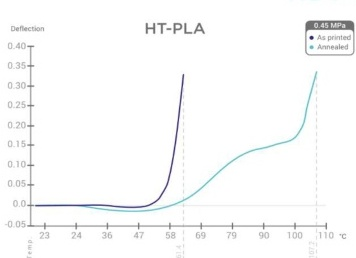
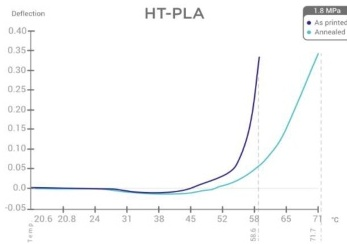
| Heat deflection temperature  | ISO 75 1.8MPa      | 58.6℃ (as printed)  |
| Heat deflection temperature  | ISO 75 0.45MPa     | 61.4℃ (as printed)  |
| Vicat softening temperature  | ISO 306, GB/T 1633 | 155.2℃ (annealed)   |
| Heat deflection temperature  | ISO 75 1.8MPa      | 71.7℃ (annealed)    |
| Heat deflection temperature  | ISO 75 0.45MPa     | 107.2℃ (annealed)   |

## Curva de HDT

<figure><img src="/files/HHdsmCEArJoSYjqJ7nWt" alt=""><figcaption></figcaption></figure>

<figure><img src="/files/MWPkDBhWFcwiOsxkA2Eq" alt=""><figcaption></figcaption></figure>

### **Propriedades mecânicas (como impresso)**

| Property                                       | Testing Method     | Typical Value      |
| ---------------------------------------------- | ------------------ | ------------------ |
| Young's modulus (X-Y)                          | ISO 527, GB/T 1040 | 2945.75±77.35 MPa  |
| Young's modulus (Z)                            | ISO 527, GB/T 1040 | 2596.43±160.44 MPa |
| Tensile strength (X-Y)                         | ISO 527, GB/T 1040 | 42.86±0.76 MPa     |
| Tensile strength (Z)                           | ISO 527, GB/T 1040 | 20.83±0.51 Mpa     |
| Elongation at break (X-Y)                      | ISO 527, GB/T 1040 | 2.80±0.26 %        |
| Elongation at break (Z)                        | ISO 527, GB/T 1040 | 0.97±0.05 %        |
| Bending modulus (X-Y)                          | ISO 178, GB/T 9341 | 2893.46±53.15 MPa  |
| Bending modulus (Z)                            | ISO 178, GB/T 9341 | 2411.22±139.22 MPa |
| Bending strength (X-Y)                         | ISO 178, GB/T 9341 | 74.04±0.66 MPa     |
| Bending strength (Z)                           | ISO 178, GB/T 9341 | 29.39±1.18 Mpa     |
| <p>Notched Charpy impact<br>strength (X-Y)</p> | ISO 179, GB/T 1043 | 4.94±0.31 kJ/m2    |
| <p>Notched Charpy impact<br>strength (Z)</p>   | ISO 179, GB/T 1043 | 4.50±0.11 kJ/m2    |

### **Propriedades mecânicas (após recozimento)**

| Property                                       | Testing Method     | Typical Value      |
| ---------------------------------------------- | ------------------ | ------------------ |
| Young's modulus (X-Y)                          | ISO 527, GB/T 1040 | 3267.16±66.41 MPa  |
| Young's modulus (Z)                            | ISO 527, GB/T 1040 | 2596.43±160.44 MPa |
| Tensile strength (X-Y)                         | ISO 527, GB/T 1040 | 42.86±0.76 MPa     |
| Tensile strength (Z)                           | ISO 527, GB/T 1040 | 18.82±0.98 MPa     |
| Elongation at break (X-Y)                      | ISO 527, GB/T 1040 | 1.87±0.09 %        |
| Elongation at break (Z)                        | ISO 527, GB/T 1040 | 0.81±0.08 %        |
| Bending modulus (X-Y)                          | ISO 178, GB/T 9341 | 2960.42±46.91 MPa  |
| Bending modulus (Z)                            | ISO 178, GB/T 9341 | 2411.22±139.22 MPa |
| Bending strength (X-Y)                         | ISO 178, GB/T 9341 | 66.75±0.51 MPa     |
| Bending strength (Z)                           | ISO 178, GB/T 9341 | 28.95±1.44 MPa     |
| <p>Notched Charpy impact<br>strength (X-Y)</p> | ISO 179, GB/T 1043 | 4.67±0.20 kJ/m2    |
| <p>Notched Charpy impact<br>strength (Z)</p>   | ISO 179, GB/T 1043 | 4.39±0.18 kJ/m2    |

* Baseado em bico de 0,4 mm. As condições de impressão podem variar com outros diâmetros.

Para maior estabilidade térmica, você pode recozer este material por `3 min` a `80–90°C`.

## Corpo de prova para ensaio de tração

ISO 527, GB/T 1040

![](https://web-api.textin.com/ocr_image/external/309d88e5883fce10.jpg)

![](https://web-api.textin.com/ocr_image/external/1238ecf75f9d7af7.jpg)

## Corpo de prova para ensaio de flexão

ISO 178,GB/T 9341

![](https://web-api.textin.com/ocr_image/external/7d4c276bd3b67df3.jpg)

![](https://web-api.textin.com/ocr_image/external/6ba817935e7eedde.jpg)

## Corpo de prova para ensaio de impacto

ISO 179,GB/T 1043

![](https://web-api.textin.com/ocr_image/external/ff207e53afda9470.jpg)

![](https://web-api.textin.com/ocr_image/external/3a95a922695ba44f.jpg)

![](https://web-api.textin.com/ocr_image/external/50d597b6fa32f796.jpg)

## Como produzir os corpos de prova

| Printing temperature      | 230℃                |
| ------------------------- | ------------------- |
| Bed temperature           | 50℃                 |
| Shell                     | 2                   |
| Top & bottom layer        | 3                   |
| Infill                    | 100%                |
| Environmental temperature | Ambient temperature |
| Cooling fan               | ON                  |

### Aviso

Os valores típicos apresentados nesta ficha técnica servem apenas como referência e comparação. Eles não devem ser usados como especificação de projeto nem como critério de controle de qualidade. Os valores reais podem variar significativamente conforme as condições de impressão. O desempenho final de peças impressas depende não só do material, mas também do projeto da peça, das condições ambientais, dos parâmetros de impressão e de outros fatores. As especificações do produto podem mudar sem aviso prévio.

Cada usuário é responsável por determinar a segurança, a conformidade legal, a adequação técnica e as práticas corretas de descarte ou reciclagem dos materiais Polymaker para a aplicação pretendida. A Polymaker não oferece garantia de qualquer tipo, salvo quando anunciado separadamente, quanto à adequação para um uso ou aplicação específica. A Polymaker não poderá ser responsabilizada por danos, lesões ou perdas decorrentes do uso de materiais Polymaker em qualquer aplicação.


---

# Agent Instructions
This documentation is published with GitBook. GitBook is the documentation platform designed so that both humans and AI agents can read, navigate, and reason over technical content effectively. Learn more at gitbook.com.

## Querying This Documentation
If you need additional information that is not directly available in this page, you can query the documentation dynamically by asking a question.

Perform an HTTP GET request on the current page URL with the `ask` query parameter:

```
GET https://wiki.polymaker.com/polymaker-wiki/polymaker-wiki-pt/produtos-polymaker/mais-sobre-nossos-produtos/documentos/fichas-tecnicas/pla/ht-pla.md?ask=<question>
```

The question should be specific, self-contained, and written in natural language.
The response will contain a direct answer to the question and relevant excerpts and sources from the documentation.

Use this mechanism when the answer is not explicitly present in the current page, you need clarification or additional context, or you want to retrieve related documentation sections.