> For the complete documentation index, see [llms.txt](https://wiki.polymaker.com/llms.txt). Markdown versions of documentation pages are available by appending `.md` to page URLs; this page is available as [Markdown](https://wiki.polymaker.com/the-basics/fun-3d-printing-facts/pla-can-be-weather-resistant.md).
# PLA Can Be Weather Resistant
Many people don’t usually consider PLA to be weather resistant because it is well-known for having a relatively low heat resistance compared to other engineering plastics. However, PLA can actually exhibit surprisingly good resistance to UV exposure and various weather conditions when it is formulated and processed correctly. While traditional PLA may degrade more quickly under prolonged sunlight or outdoor exposure, specially engineered PLA variants can hold up much better in these environments than commonly assumed.
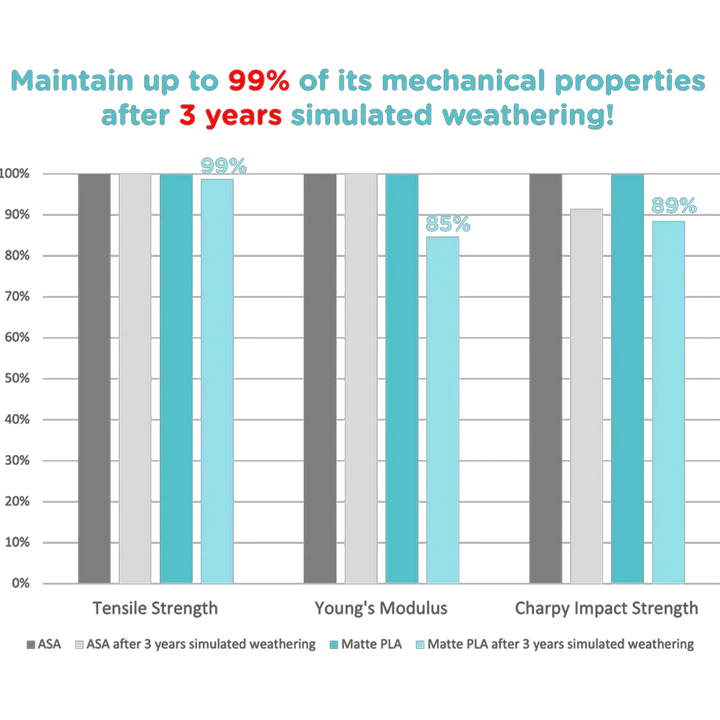
For example, Polymaker’s Matte PLA for Production has been subjected to rigorous weather resistance testing, which demonstrated that it performs on par with ASA, a material widely recognized for its excellent UV and weather durability. This means that, despite the typical perception of PLA as a material better suited for indoor or low-stress applications, certain advanced PLA formulations like Polymaker’s Matte PLA can be confidently used for outdoor projects or parts exposed to sunlight without rapid degradation. This opens new possibilities for using PLA in functional applications where both aesthetic finish and environmental resistance are important.
{% embed url="" %}
---
# Agent Instructions
This documentation is published with GitBook. GitBook is the documentation platform designed so that both humans and AI agents can read, navigate, and reason over technical content effectively. Learn more at gitbook.com.
## Querying This Documentation
If you need additional information that is not directly available in this page, you can query the documentation dynamically by asking a question.
Perform an HTTP GET request on the current page URL with the `ask` query parameter, and the optional `goal` query parameter:
```
GET https://wiki.polymaker.com/the-basics/fun-3d-printing-facts/pla-can-be-weather-resistant.md?ask=&goal=
```
`ask` is the immediate question: it should be specific, self-contained, and written in natural language.
`goal` is optional and describes the broader end goal you are ultimately trying to accomplish on behalf of the user. GitBook uses it to tailor the answer towards what is most useful for that goal.
The response will contain a direct answer to the question and relevant excerpts and sources from the documentation.
Use this mechanism when the answer is not explicitly present in the current page, you need clarification or additional context, or you want to retrieve related documentation sections.